 Warehouse racking carries thousands of pounds of stock every day. It works hard and often takes knocks from forklifts, pallets, and daily movement.
So, it’s no surprise that one of the most common questions we hear is: how often should racking be inspected?
The short answer is simple.
Racking should be checked regularly by your team and inspected at least once every 12 months by a competent specialist.
In this guide, we explain:
- What the law expects
- The different types of inspection
- How to decide your ideal racking inspection frequency
- What happens during a warehouse racking inspection
- Common mistakes to avoid
We’ll keep it clear and practical so you can take action straight away.
Why Regular Racking Inspections Matter
Racking damage is rarely dramatic at first.
It usually starts small. A slight bend in an upright. A missing locking clip. A loose floor fixing.
Left unchecked, these small issues weaken the structure. Over time, that increases the risk of collapse.
A failed rack can:
- Injure staff
- Destroy stock
- Damage forklifts
- Shut down aisles
- Lead to enforcement action.
Under UK health and safety law, racking is classed as work equipment. That means it falls under PUWER and wider warehouse safety compliance duties.
An effective warehouse racking safety inspection process protects both your people and your business.
What Do Regulations Actually Require?
In the UK, guidance from the HSE and industry bodies such as SEMA recommends three levels of inspection:
1. Continuous Monitoring (Daily Awareness)
Every warehouse should have a Person Responsible for Racking Safety (PRRS).
Staff should report damage immediately. If a forklift hits a frame, it must not be ignored.
This is your first line of defence.
2. Regular Visual Inspections (Weekly or Monthly)
Your PRRS should carry out formal visual checks at regular intervals.
In busy warehouses, this may be weekly. In lower traffic areas, monthly may be suitable.
These checks should be recorded. Logging damage trends helps with long-term rack damage assessment.
3. Expert Inspection (At Least Once Per Year)
A thorough annual racking inspection must be completed by a technically competent person.
This is often referred to as a SEMA racking inspection.
For most sites, this yearly expert racking inspection is the minimum requirement.
If racking is altered, relocated, or significantly damaged, an additional inspection should take place immediately.
How Often Should Racking Be Inspected in Busy Warehouses?
There is no one-size-fits-all answer.
Your ideal racking inspection frequency depends on:
- Forklift traffic levels
- Number of operators
- Type of goods stored
- Rack height and layout
- Previous damage history
- Floor condition
- Temperature conditions
For example:
- A high-volume distribution centre may need quarterly formal inspections.
- A small storage warehouse with limited forklift use may operate safely with annual inspections plus monthly checks.
If you are unsure, it is safer to inspect more often rather than less.
What Happens During a Warehouse Racking Inspection?
A professional industrial racking inspection looks closely at key structural components:
- Uprights
- Beams
- Frame bracing
- Base plates
- Floor fixings
- Locking pins and safety clips
Damage is usually categorised using a traffic light system:
- Green – Monitor only
- Amber – Repair required but not immediate
- Red – Immediate unloading and isolation required
This structured approach makes decision-making clear and defensible.
A Simple Inspection Framework We Recommend
To make things easy, we advise clients to follow this structure:
Step 1 – Train your team
Ensure staff understand what damage looks like.
Step 2 – Record everything
Even minor impacts should be logged.
Step 3 – Protect vulnerable areas
Install protective systems where impact risk is high.
Step 4 – Schedule your annual expert inspection
Do not wait until the end of the year to think about it.
Practical Example
Let’s say you operate a warehouse with 12 forklifts and multiple picking aisles.
Your ideal approach would likely be:
- Daily reporting culture
- Weekly PRRS checks
- Quarterly internal review
- Annual expert racking inspection
Now compare that to a smaller facility with two forklifts and low pallet turnover. Monthly checks plus an annual inspection may be sufficient.
The key is risk level, not company size.
How to Reduce Racking Damage in the First Place
Prevention is always cheaper than repair.
We often recommend impact protection systems such as:
- Safety barriers to shield rack ends
- Anti-collapse mesh for racking to prevent falling stock
- Pallet racking cages for secure or hazardous goods
- Mesh partitioning to separate walkways and forklift routes
In some cases, additional solutions such as machine guarding or modular fencing improve overall warehouse safety compliance.
The right physical protection reduces long-term inspection costs.
Common Mistakes We See
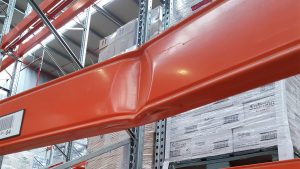
Many businesses unintentionally put themselves at risk by:
- Assuming installation teams are qualified inspectors
- Ignoring small dents
- Failing to log damage
- Skipping the annual inspection
- Reloading amber-rated racks before repair
- Treating racking as permanent infrastructure instead of work equipment
A PUWER racking inspection approach removes that uncertainty and provides a documented audit trail.
Final Thoughts
Racking inspections are not just a box-ticking exercise. They are practical safety controls that protect people, stock, and reputation.
If you are asking how often racking should be inspected, it usually means you already know it matters.
At Billington Safety Systems, we help warehouses create safer working environments through expert advice, protective systems and tailored safety solutions. Alongside racking protection, we design and install storage cages, partitioning systems, warehouse offices, machine guarding and complete safety upgrades to improve compliance and efficiency.
If you would like guidance on improving your warehouse safety setup or want to review your current inspection strategy, get in touch with our team.
We’re always happy to have a straightforward conversation about what will genuinely improve your site.