
A fence around a factory and a fence around a machine may look similar, but they protect against different risks. Choosing between them starts with understanding what you need to keep people away from, rather than simply deciding where the panels should go.
Boundary fencing usually controls access to land or premises. Machine perimeter guarding separates people from hazardous machinery and forms part of a wider safety system. That distinction matters when planning a production area, changing equipment or specifying protection for an existing installation.
What does perimeter fencing actually mean?
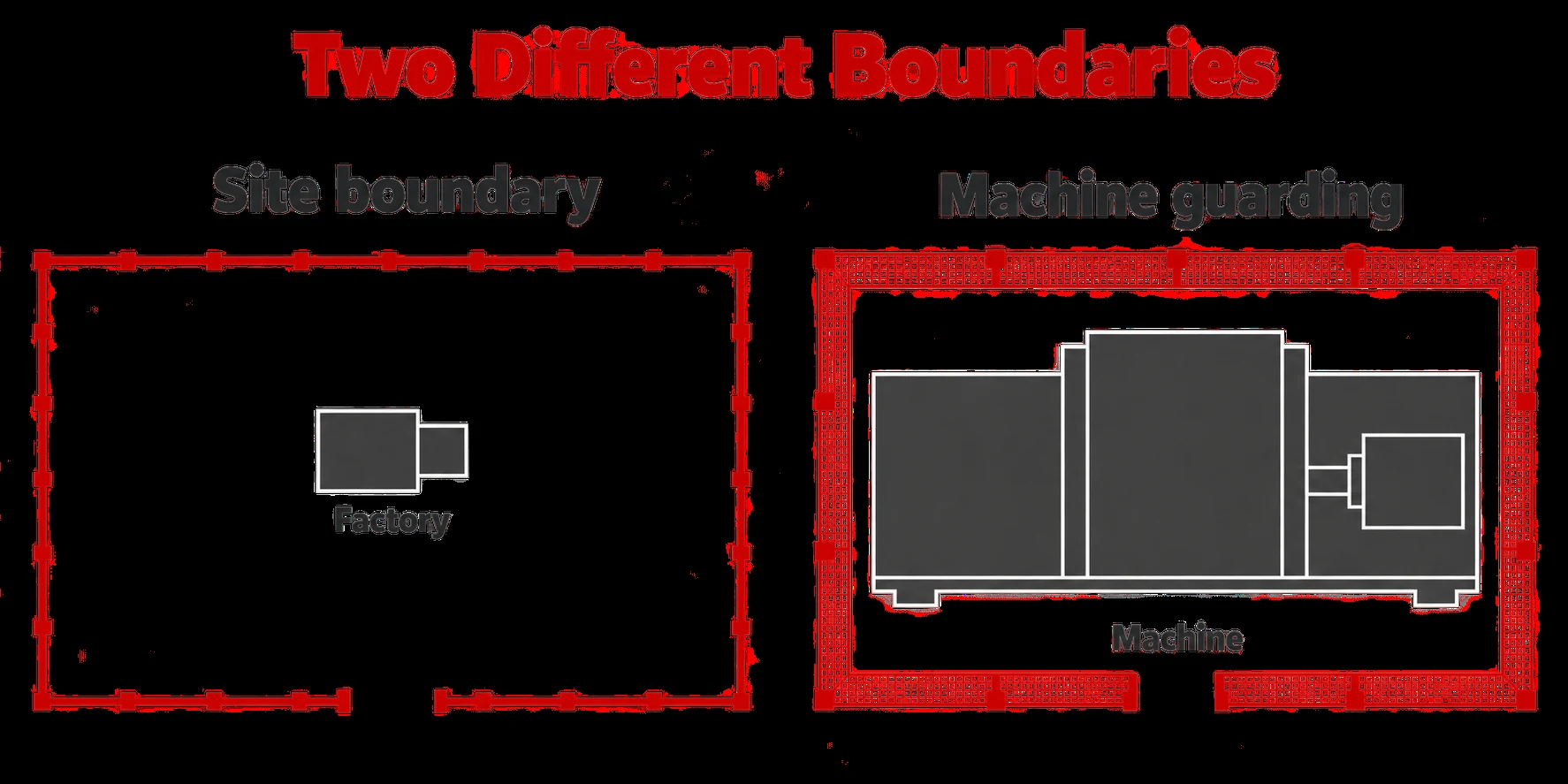
A perimeter fence is a fence around the outer edge of an area. The term describes its position, not its safety performance. That area could be an entire industrial site, a storage compound or a machinery installation.
General boundary fencing typically helps define ownership, discourage unauthorised access and direct visitors towards controlled entrances. Its specification may focus on security, durability and the conditions around the site.
Machine perimeter guarding has a different purpose. It creates a protective boundary around equipment such as automated production lines, robot cells, conveyors or palletising machinery. The panels, posts, fixings and access arrangements must suit the hazards within that boundary.
When discussing perimeter guarding for machinery, describe the equipment and the risks it presents. Asking only for a perimeter fence leaves important questions unanswered, including whether anyone can reach dangerous parts and what must happen when a gate opens.
Why boundary fencing cannot automatically serve as a machine guard
A fence can prevent someone walking into an area while still allowing them to reach a dangerous moving part. It may also leave gaps underneath, provide footholds or lack the strength needed for the application. A secure site boundary does not establish that machinery inside it is adequately guarded.
Machine guarding needs to address foreseeable contact with hazards during operation, cleaning, fault finding and maintenance. Depending on the equipment, the assessment may also need to consider ejected components, material discharge or other hazards that a basic mesh panel would not contain.
The main differences are practical:
- Purpose: boundary fencing manages access to premises; machine guarding restricts access to machinery hazards.
- Position: machine guards must maintain suitable separation from dangerous parts, not just follow a convenient floor line.
- Access: a machinery gate may need to interact with the machine control system rather than simply have a latch.
- Construction: panels, supports and fixings must remain effective under foreseeable conditions of use.
This does not mean every machine needs the same enclosure. It means the specification must follow the risk assessment, rather than appearance or a general fencing description.
Safety distances and access gates need to work together
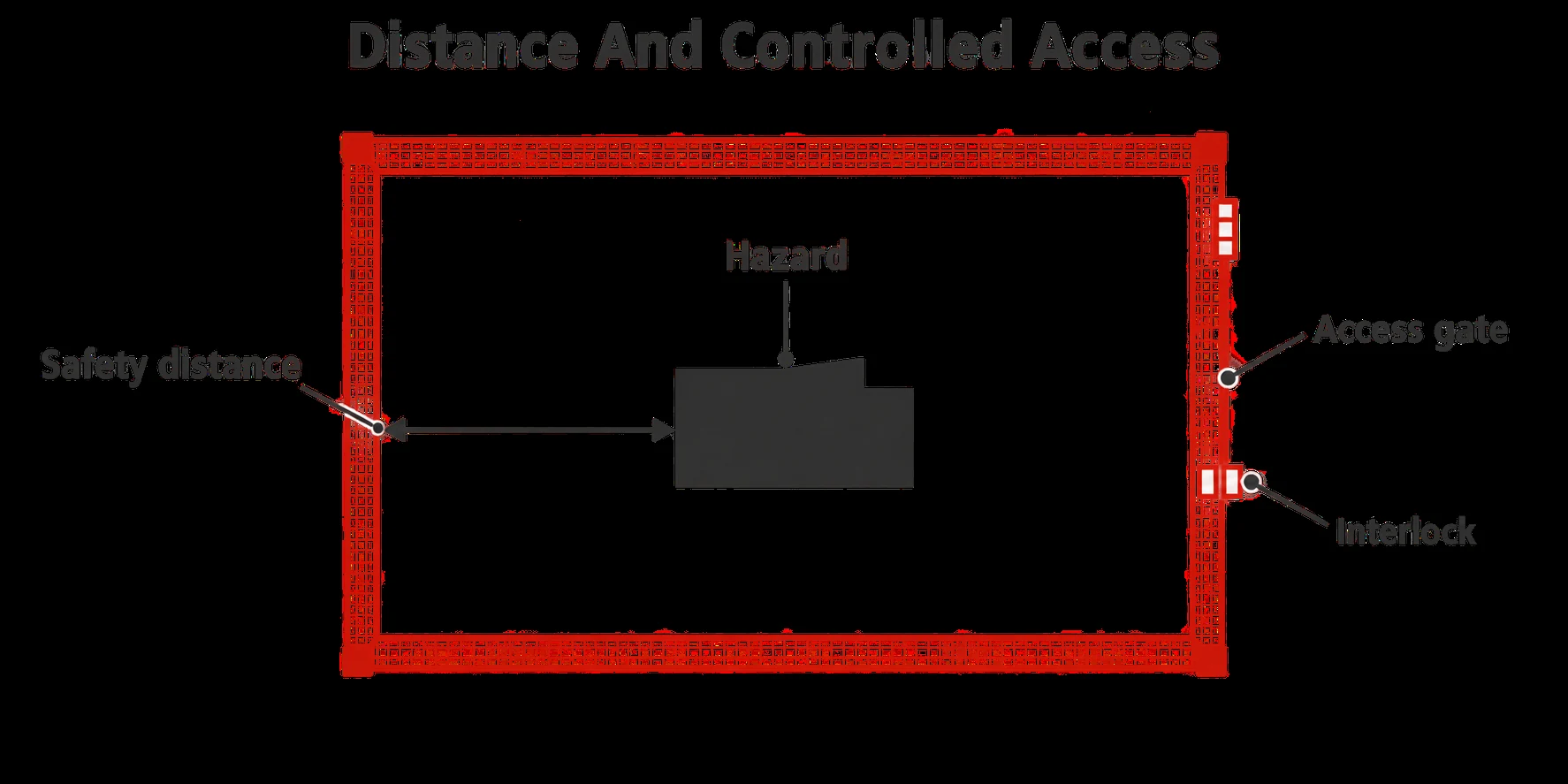
Guard height alone does not determine whether a perimeter is safe. People may be able to reach over, under or through it. Mesh opening size, ground clearance and the distance between the guard and the hazard must therefore be considered together.
There is no single safe distance that applies to every installation. A competent designer should use the risk assessment and relevant standards, including BS EN ISO 13857 for safety distances, to establish suitable dimensions.
Access gates need equal attention. Where an interlocked gate is required, opening it should prevent or stop the relevant hazardous functions through an appropriately designed safety control system. Closing the gate should not, by itself, restart hazardous movement.
If a person could reach the hazard before dangerous movement has stopped, guard locking may be needed to keep the gate closed until access is safe. Stored energy and other continuing hazards also need consideration.
For enclosures that people can enter fully, the design must address the possibility of someone remaining inside. Depending on the application, measures may include escape release, presence detection or a controlled access procedure. Interlocking does not replace safe isolation where maintenance or other tasks require it.
Specify guarding around the work people actually do
Effective perimeter guarding supports normal production while keeping access controlled. Start by mapping how operators load materials, remove finished products, inspect equipment and deal with routine stoppages. Include cleaners and maintenance staff, not just the people running the machine.
A useful specification should cover:
- The machinery layout, hazardous movements and any equipment working together.
- Routine access points and how often each task requires entry.
- Material transfer openings, including conveyor entries and exits.
- Space for maintenance, component removal and safe working positions.
- Nearby pedestrian routes, vehicle movements and emergency escape routes.
- Floor conditions, fixing requirements and the operating environment.
Material openings deserve particular care because they can create a route into the guarded area. Their protection must allow the intended process without leaving people exposed to the machinery.
Where layouts may change, modular machine guarding and safety fencing can provide a practical basis for adaptation. Any alteration still needs review, because moving a panel or adding a gate can change safety distances, access routes and control requirements.
Check the complete installation, not just the panels
In UK workplaces, the Provision and Use of Work Equipment Regulations, commonly called PUWER, require employers to take effective measures to prevent access to dangerous machinery parts or stop their movement before a person enters a danger zone. Installing a fence alone does not demonstrate that these duties have been met.
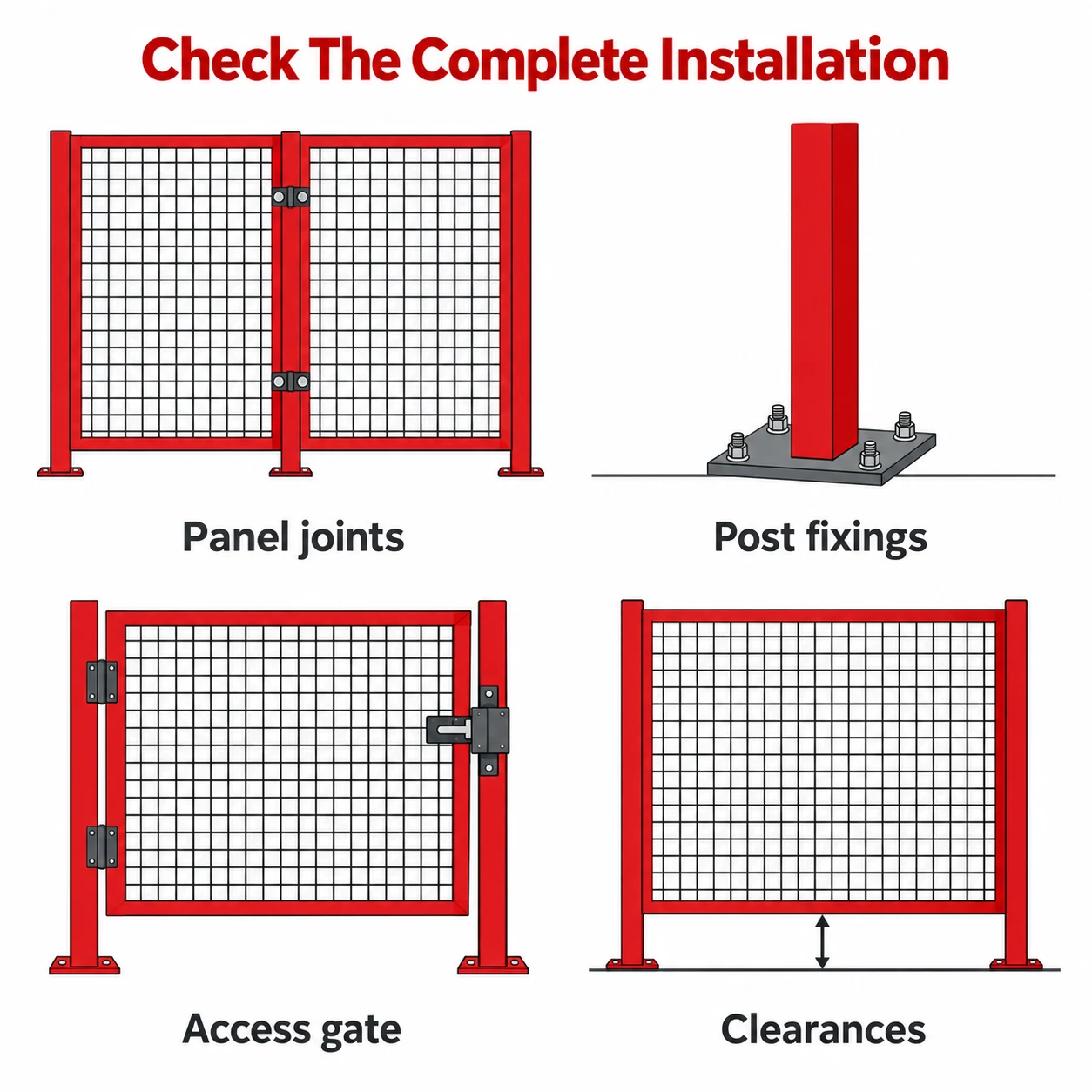
Before the equipment is put into use, check the complete guarding arrangement against its intended safety functions. This includes panel security, openings, separation distances, gate operation and the response of the machinery when access is requested or a gate is opened.
Relevant standards include BS EN ISO 14120 for guards and BS EN ISO 14119 for interlocking devices associated with guards. The standards applicable to the particular machine also matter. Our guidance on machinery guarding and regulatory compliance explains the wider responsibilities.
Keep inspection and maintenance arrangements proportionate to the risks and conditions of use. Damaged panels, loose fixings, altered gaps and defeated interlocks can undermine protection. Review the guarding whenever machinery, processes or access needs change, and make sure staff understand how to report defects and work safely around the enclosure.
- Boundary fencing controls access to premises; machine perimeter guarding protects people from machinery hazards.
- Guard height, openings and distance from hazards must be assessed together.
- Access gates may need interlocking, guard locking and measures to protect anyone inside.
- Changes to machinery or guarding should trigger a safety review.
Frequently asked questions
Can existing security fencing be used around machinery?
Only if a competent assessment establishes that the complete arrangement meets the machinery guarding requirements. Its height or strength alone is not enough. Openings, safety distances, fixings and access controls all need checking.
Does every machine guarding gate need an interlock?
The appropriate arrangement depends on the hazards and access needs. Frequent access to a danger zone will often call for an interlocked movable guard. Where hazards continue after a stop signal, guard locking may also be necessary.
Is perimeter guarding enough to protect a whole production line?
It can form a major part of the protection, but individual hazards may need additional measures. Transfer openings, accessible machinery outside the enclosure and tasks performed inside it must all be assessed.
Can perimeter guarding be moved when a factory layout changes?
Many systems can be adapted. Before the revised installation is used, reassess hazard distances, access points and safety controls. Check that the new arrangement still protects people during production, cleaning and maintenance.
Start with the machinery and its hazards
If you are planning a new enclosure or reviewing existing protection, talk to Billington Safety Systems about your machinery, layout and access needs. We can help you explore a practical perimeter guarding arrangement for your workplace.