
Road safety is not just about road signs, speed limits, or painted lines. One of the most important parts of road safety is the physical protection built into the road. This is where crash barrier fencing systems play a key role.
We see these barriers every day on motorways, bridges, and busy roads, but many people don’t think about what they actually do. In this guide, we explain how crash barriers help keep people safe, reduce the impact of accidents, and protect both drivers and pedestrians.
What are crash barrier fencing systems?
Crash barrier fencing systems are engineered road safety barriers designed to manage vehicle impact. Their job is simple but critical to control what happens when a vehicle leaves its lane.
Instead of allowing a vehicle to cross into oncoming traffic, hit a solid object, or enter a pedestrian area, the barrier absorbs energy and redirects the vehicle in a safer direction. This reduces the chance of serious injury, secondary collisions, and fatalities.
These systems are a core part of modern road infrastructure safety and are widely used across highways, bridges, junctions, and high-risk roadside locations.
How crash barriers reduce road accidents?
Crash barriers don’t prevent accidents from happening. What they do is dramatically reduce how severe those accidents become.
When a vehicle impacts a barrier:
- The barrier absorbs and spreads impact energy
- The vehicle is slowed down in a controlled way
- The barrier guides the vehicle away from hazards
- The risk of rollovers or head-on collisions is reduced
This is why crash barriers are such an important part of highway safety engineering and traffic protection planning.
Impact absorption: the key to saving lives
One of the biggest safety benefits comes from impact-absorbing road barriers.
Instead of stopping a vehicle abruptly, modern barriers are designed to flex, deform, or deflect. This controlled movement reduces the force transferred to the people inside the vehicle.
Energy-absorbing designs are especially important on:
- High-speed roads
- Bridge approaches
- Central reservations
- Areas with limited run-off space
This is where vehicle restraint systems prove their value, turning a potentially fatal impact into a survivable one.
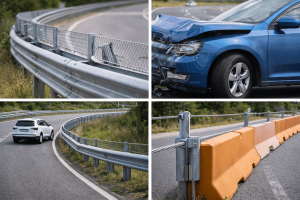
Redirecting vehicles away from danger
Another major role of crash barriers is vehicle guidance.
Barriers are positioned to prevent vehicles from:
- Crossing into opposing traffic
- Leaving elevated road sections
- Hitting fixed roadside hazards
- Entering pedestrian zones
Road crash barriers help guide a vehicle after an impact, reducing chaos and keeping traffic safer. This protection is important on both busy city roads and fast-moving motorways.
Types of road crash barriers and fencing
Different locations require different solutions. There is no “one-size-fits-all” approach to road safety barriers.
Common types include:
- Steel beam barriers for general roadside protection
- Cable systems that flex and absorb energy
- Concrete barriers for high-impact or high-speed zones
- Pedestrian and vehicle safety fencing for urban roads
Each option is chosen based on speed limits, traffic volume, available space, and nearby risks.
In some places, road safety measures are used together with other safety systems, such as barriers for pedestrians, fencing around the area, or controlled entry points.
Why standards and compliance matter?
Crash barriers only work when they are properly designed, installed, and maintained.
UK roadside safety barrier standards ensure that:
- Barriers perform predictably during impact
- Materials meet durability requirements
- Installations suit real-world traffic conditions
Compliance isn’t about ticking boxes. It’s about ensuring that when something goes wrong, the system works exactly as intended.
Road safety is part of a bigger protection strategy
Crash barriers are just one part of a wider safety picture.
In industrial and infrastructure environments, protection often extends beyond the road edge. For example, we regularly see projects that combine road safety barriers with solutions like perimeter guarding, modular fencing, or mesh partitioning to manage movement and reduce risk.
In warehouses and logistics hubs, similar principles apply. Systems such as warehouse safety systems, mezzanine floor guards, and machine safety guards all work towards the same goal of separating people from danger.
Long-term value of crash barrier fencing systems
The benefits of crash barrier fencing for road safety go beyond accident reduction.
Well-designed systems:
- Lower long-term injury and repair costs
- Reduce road closures after accidents
- Protect roadside infrastructure
- Improve confidence for all road users
In short, they make roads more predictable, safer, and easier to manage.
Our approach at Billington Safety Systems
At Billington Safety Systems, we believe safety should always be practical, reliable, and fit for real-world use.
We design and deliver protective systems that support road safety while integrating seamlessly with wider environments. From safety fencing for roads to partitioning systems, storage cages, and gantry platforms, our focus is on reducing risk without overcomplicating solutions.
If you’re planning a project involving road safety, pedestrian protection, or controlled access, we’re here to help.
Talk to us today to find the right solution for your site with expert advice focused on safety.