
Compressors are essential in many industrial environments, but they can also be one of the most persistent sources of workplace noise. When the sound is constant, close to workstations or amplified by hard surfaces, it quickly becomes more than a background nuisance.
A well-designed acoustic enclosure helps tackle the noise where it starts: around the compressor itself. The key is to reduce sound without compromising cooling, inspection, maintenance access or safe operation.
Why compressor noise is best controlled at source
Compressor noise can travel through the air, reflect off walls and floors, and pass through gaps in nearby structures. Once it has spread across a plant room or production area, it becomes harder to control without affecting people, processes or the wider layout.
Source control is often the most practical first step because it deals with the sound before it radiates into the working environment. An acoustic enclosure surrounds the compressor with a purpose-made barrier, helping to contain airborne noise while allowing the machine to keep doing its job.
This is especially useful where compressors operate for long periods, sit near regular walkways, or are positioned close to maintenance and production teams. It can also support a wider noise control approach alongside good maintenance, isolation mounts, layout planning and appropriate hearing protection where required.
How an acoustic enclosure reduces compressor noise
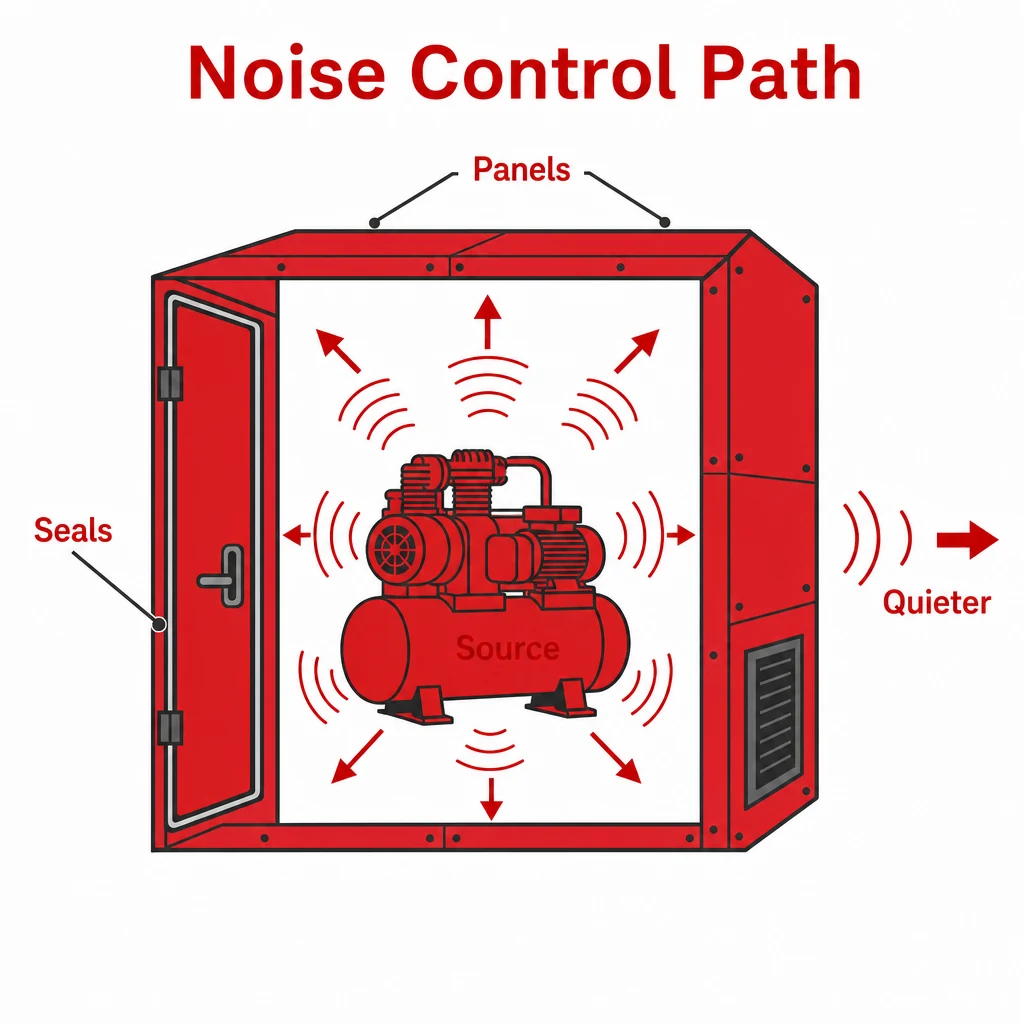
An acoustic enclosure works by combining sound blocking, sound absorption and careful detailing. The outer structure provides a physical barrier between the compressor and the surrounding workspace. The internal lining helps absorb sound energy inside the enclosure, reducing the amount that bounces around and escapes.
The most effective designs pay close attention to weak points. Doors, panel joints, cable routes, pipe penetrations and ventilation openings all need to be considered because sound will find the easiest path out. Good seals, close-fitting panels and properly detailed interfaces are just as important as the panel material itself.
For compressor applications, the design may include acoustic louvres, attenuated vents, removable panels and access doors. These features allow airflow and usability while limiting noise escape. If you are reviewing options for acoustic enclosures for compressors, the enclosure should be designed around the actual machine, not treated as a simple box around it.
Ventilation and heat management must be built in
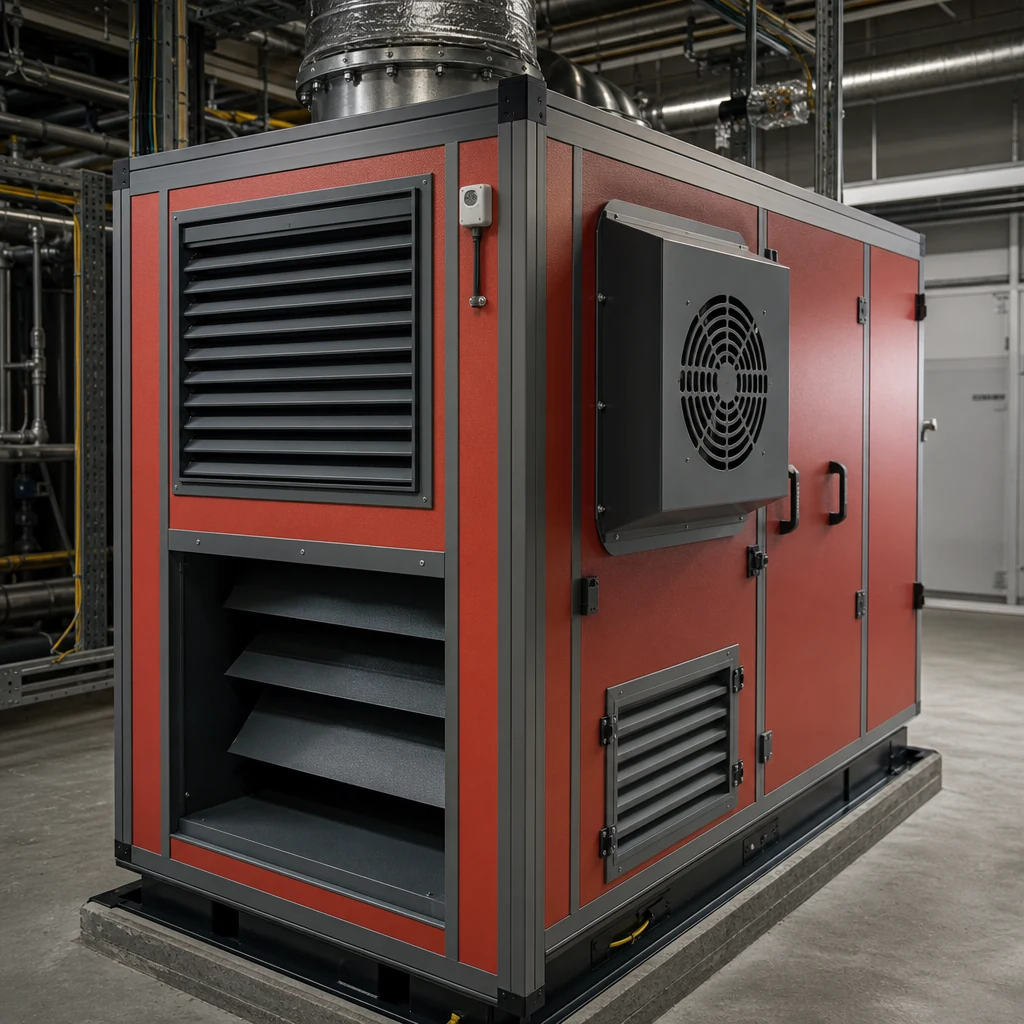
Compressors generate heat, and many rely on a steady flow of air for cooling. Reducing noise must never mean restricting the machine’s ability to breathe. An enclosure that blocks airflow can lead to poor performance, overheating, unnecessary downtime and additional strain on components.
This is why ventilation is a core part of acoustic enclosure design. The aim is to provide enough intake and exhaust airflow while controlling the noise that would otherwise escape through those openings. Acoustic louvres, ducted routes or attenuators may be used depending on the compressor, available space and heat load.
Air paths should be planned so that warm air is removed effectively and not simply recirculated back into the intake. Designers also need to account for manufacturer clearances, service requirements and any existing extraction or ventilation in the room. A good enclosure reduces noise while helping the compressor operate within its intended conditions.
Access, inspection and safe operation
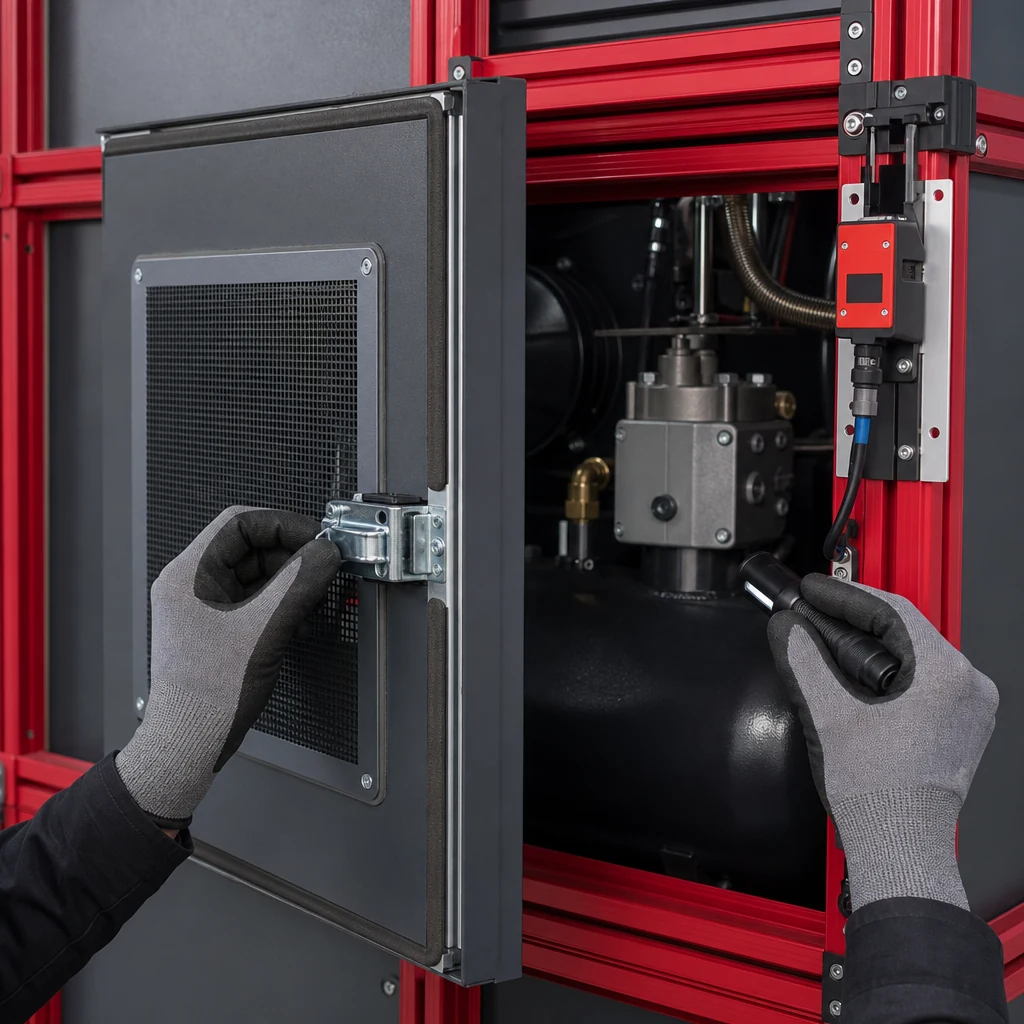
Compressors need regular checks, servicing and safe isolation. A practical acoustic enclosure should make these tasks straightforward. If access is awkward, panels are difficult to remove or key controls are hidden, the enclosure is not doing its job properly.
Useful access features can include hinged doors, removable sections, viewing panels, lift-off panels and clearly defined service openings. These should be positioned around the parts of the compressor that engineers need to reach, such as filters, gauges, valves, oil points, control panels and isolation points.
Safety also needs to remain visible and accessible. Emergency stops, warning lights, labels and isolation equipment should not be obscured. Doors and panels should be secure in normal operation, with fixings and hardware suitable for the industrial setting. Where a compressor is located near pedestrian routes, the enclosure can also help create a cleaner, more controlled boundary around the equipment.
Fitting the enclosure into the wider workspace
An acoustic enclosure does not exist in isolation. It has to fit around pipework, electrical supplies, drainage, existing guards, barriers, walkways and maintenance routes. In busy industrial environments, a neat and robust installation can make a significant difference to both safety and usability.
Aluminium-profile framing is often useful because it can create a clean, modular structure with accurate panel alignment. Powder-coated panels, mesh sections where appropriate, robust door hardware and clear access zones can all help the finished enclosure look professional and perform reliably.
The surrounding environment matters too. Hard floors, block walls, steelwork and ceilings can reflect sound, so the enclosure design should consider how noise behaves in the actual space. Where there are multiple noise sources, the compressor enclosure may be one part of a wider improvement plan rather than the only measure required.
What to consider before specifying an enclosure
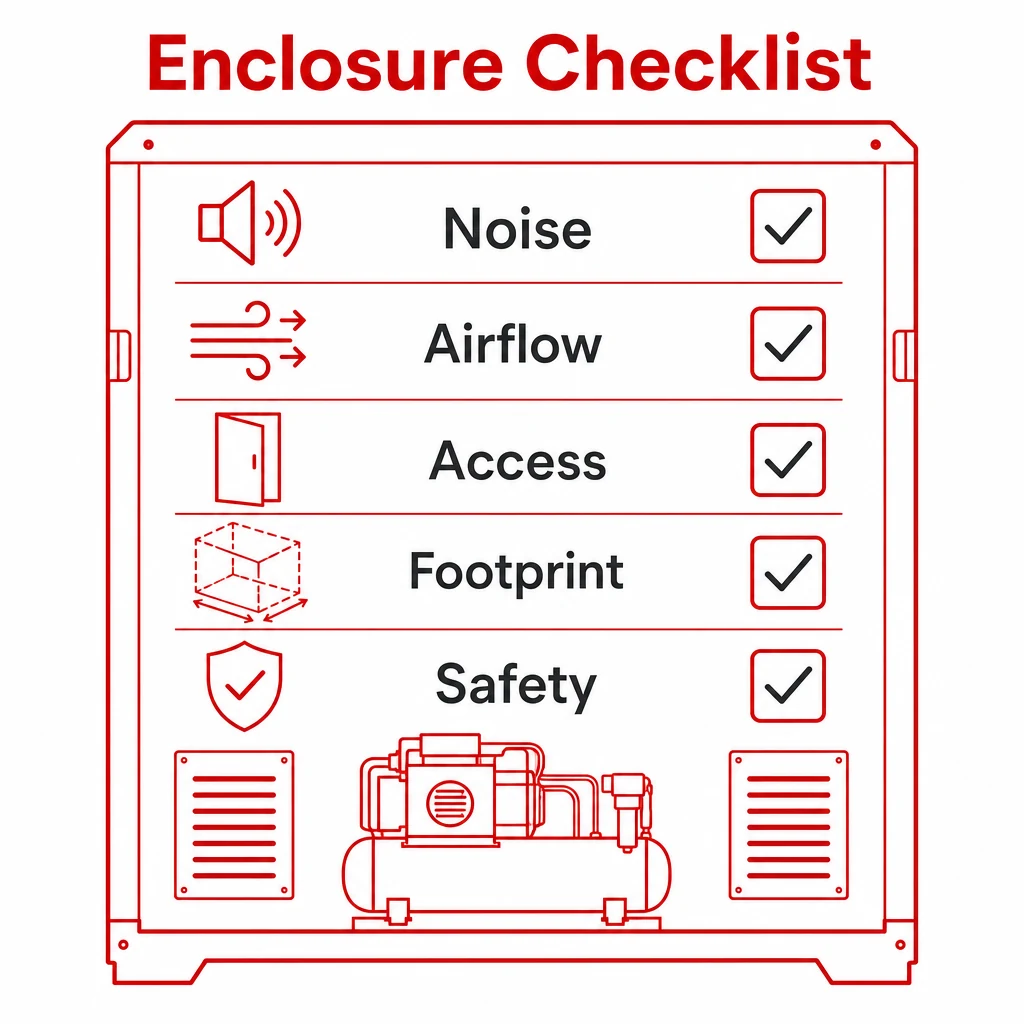
Before an acoustic enclosure is designed, it is worth gathering practical information about the compressor and its setting. This helps the enclosure meet the needs of operators, maintenance teams and the equipment itself.
- The compressor make, model, size and heat output, where available.
- Required maintenance access and panel clearance zones.
- Air intake and exhaust positions.
- Pipework, cable routes and floor fixings.
- Nearby walkways, workstations and traffic routes.
- Any operational constraints, such as continuous running or shift patterns.
It is also sensible to think about future maintenance. If filters, belts or serviceable components need frequent attention, the enclosure should make those tasks easy to complete. Good design balances acoustic performance with everyday practicality.
- Acoustic enclosures control compressor noise by treating it close to the source.
- Ventilation, cooling and airflow must be designed in from the start.
- Doors, seals, joints and service openings are critical to performance.
- A good enclosure preserves safe access for inspection, isolation and maintenance.
- The best results come from designing around the actual compressor and workspace.
Frequently asked questions
Can any compressor have an acoustic enclosure?
Most industrial compressors can be considered for an enclosure, but the design needs to suit the machine, airflow requirements, service access and surrounding layout.
Will an acoustic enclosure stop all compressor noise?
No enclosure can guarantee silence, but a well-designed system can significantly reduce the noise escaping into the workplace. Results depend on the compressor, enclosure design and environment.
Does an enclosure make maintenance harder?
It should not. A practical enclosure includes doors, removable panels or access points so engineers can inspect, service and isolate the compressor safely.
Why are ventilation openings not left uncovered?
Open vents allow noise to escape easily. Acoustic louvres or attenuated air paths help maintain airflow while reducing sound breakout.
Planning a compressor acoustic enclosure?
Billington Safety Systems can help design a practical enclosure that supports noise control, ventilation, access and safe operation.